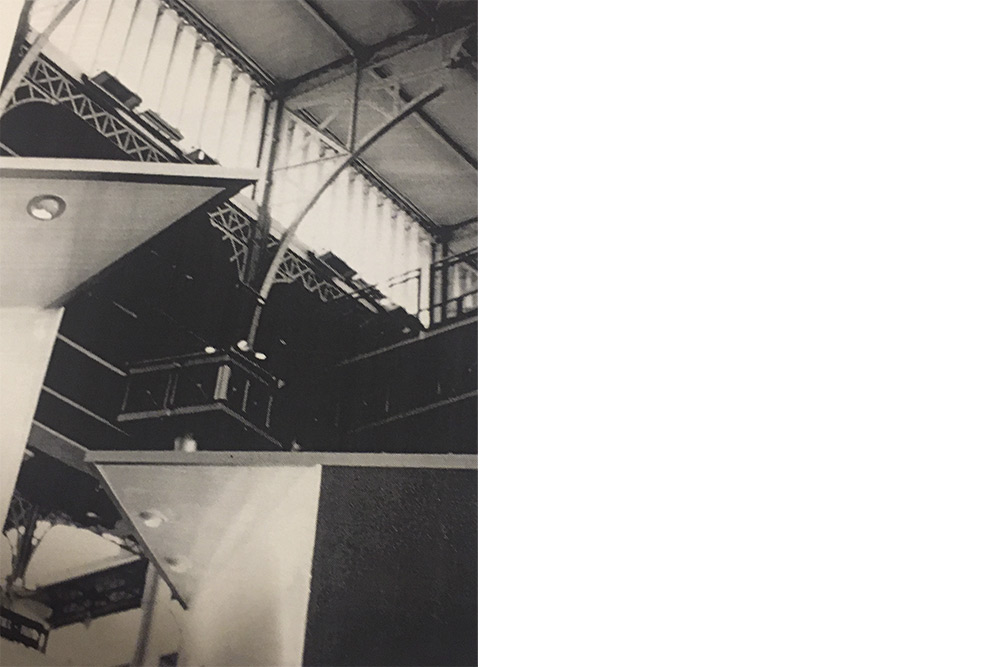
Yago Conde (Barcelona, 1957–1994) was an architect, researcher and educator. He received his doctorate in architecture from the Barcelona School of Architecture (ETSAB) and furthered his studies with a Master’s degree in Architecture at Columbia University in New York on a Fulbright scholarship. Over the course of his professional career, he worked in the offices of Peter Eisenman, Fernando Correa, Alfonso Milá and Vittorio Gregotti.
His practice developed across architecture, design and spatial experimentation, and was recognised through numerous competitions and awards. In 1987, he received the award for the best proposal for the treatment of the banks of the Guadalquivir River in Córdoba. A year later, he won first prize for the Fire Station and School in Barcelona’s Olympic Village, as well as joint first prize, together with Bea Goller, for a monumental fountain in the Olympic Village. He was selected and shortlisted for the FAD Architecture Awards in 1988, 1990 and 1991, and was a finalist in the competition for the entrances to the Alhambra in Granada in 1989. Among his projects connected to Expo ’92 in Seville were the first prize in the Thematic Landmarks competition and the construction of the entrance to the Contemporary Art Pavilion. In 1991, he was also a finalist in Fiumara d’Arte in Sicily.
Alongside his professional practice, Conde pursued an extensive international teaching career. He taught at Rensselaer Polytechnic Institute in New York and served as professor and director of the Department of Architecture at Bennington College, Vermont (1985–1986); as Unit Master at the Architectural Association in London (1986–1987); and as Professor of Architectural Design at ETSAB from 1987 to 1994. He also taught at the University of Pennsylvania in Philadelphia (1991–1993) and at Elisava (1988–1990), where he later directed the Elisava-UPC Master’s Programme in Ephemeral Architecture from 1991 to 1994.
.jpg)
.jpg)
.jpg)